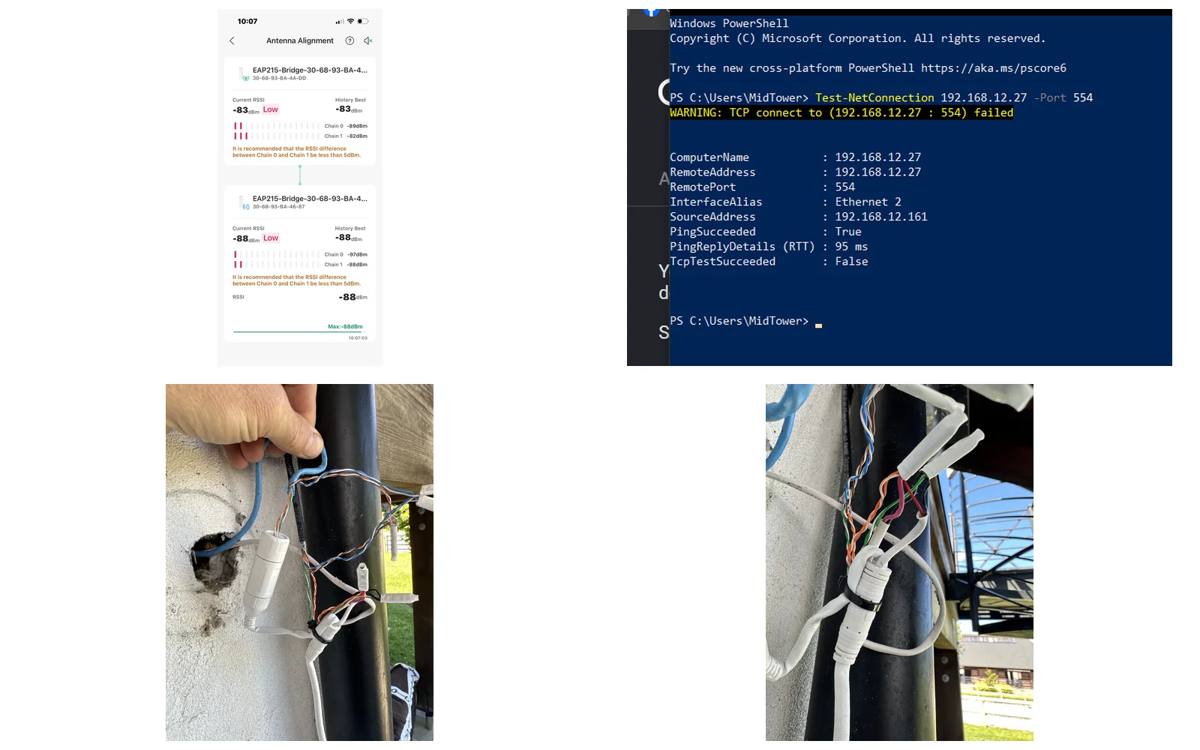
Both ends reported weak received signal. That narrows the problem to RF path, placement, alignment, obstruction, or distance before application behavior is blamed.
Case study · Production field work
Infrastructure
Real networks rarely fail in neat layers. A camera problem can be a cable problem. A Wi-Fi problem can be a backhaul problem. A passing tester can still be wrong enough to waste hours.
- Context
- Representative client and field engagements
- Environment
- Homes · barns · offices · remote structures
- Systems
- Ethernet · Wi-Fi · bridges · PoE · cameras · WAN
- Focus
- Diagnosis · remediation · integration · verification
The failure
Everything tested good. The network was still down.
One field problem began with a long Ethernet path that appeared healthy on a simple wiremap tester. All eight conductors lit. The cable was therefore treated as known-good while attention moved to switches, wireless bridges, addressing, internet service, and other parts of the system.
The assumption was wrong. The termination itself was miswired. The tester confirmed continuity, not that the link had been built correctly enough to carry Ethernet. A tool intended to reduce uncertainty had instead reinforced the wrong conclusion.
Saved field captures
What the system said while it was failing.
The values below are transcribed from saved field screenshots and photographs in the project record. They are diagnostic observations, not laboratory benchmarks.
Test-NetConnection 192.168.12.27 -Port 554
PingSucceeded : True
TcpTestSucceeded : False
Test-NetConnection 192.168.12.27 -Port 9000
PingSucceeded : True
TcpTestSucceeded : False The endpoint answered ICMP while the application ports did not. “The device is reachable” and “the service is reachable” were different facts.
Field photographs document exposed terminations, connectors, and pair handling. Continuity alone cannot prove that pair geometry and pinout are correct for Ethernet.
The method
Reduce the system until the failure has nowhere left to hide.
Establish the path
Map the complete route from service entry to the endpoint, including switches, cable segments, bridges, access points, power sources, and intermediate devices.
Verify each layer
Separate physical continuity from Ethernet link, addressing, routing, internet reachability, application behavior, and device-specific configuration.
Change one assumption at a time
Substitute known-good components and shorten paths where possible instead of making several simultaneous changes that destroy diagnostic information.
Test the intended use
A camera network is not finished when the switch lights are green. Verify the actual video path, power stability, remote access, and sustained operation.
The system view
The fault is often at the boundary.
Field infrastructure combines technologies that are individually familiar but operationally coupled. The diagnostic job is to understand the interfaces between them.
Signal quality and gateway placement establish the upstream constraint.
Switching, addressing, VLANs where applicable, and physical Ethernet create the local path.
Long cable runs and wireless bridges extend that path between buildings and difficult locations.
Cameras, access points, TVs, controllers, and IoT systems add power and protocol requirements.
The system is only complete when the user can reliably do the thing the network exists to support.
What counts as proof
Not “the light is green.” The service works.
Infrastructure work is useful evidence precisely because it is difficult to make glamorous. The result is usually quiet: stable connectivity, reachable cameras, a working bridge, predictable addressing, better signal placement, clean terminations, and fewer unexplained failures.
That is the standard: diagnose the actual fault, correct it, verify the complete path, and leave behind a system that is easier to understand than the one we found.
Representative evidence
The details are mundane. That is why they matter.
Long-run cabling, termination faults, wiremap interpretation, switch-to-switch links, and physical-layer remediation.
Building-to-building bridges, Wi-Fi coverage, access-point placement, signal constraints, and backhaul diagnosis.
PoE cameras, remote structures, mixed wired/wireless paths, internet gateways, and endpoint verification.
Selected work
Six projects. One operating standard.
The technologies change. The requirement does not: understand what is actually happening, find the real constraint, and finish with evidence that the system works.
Return to selected work →